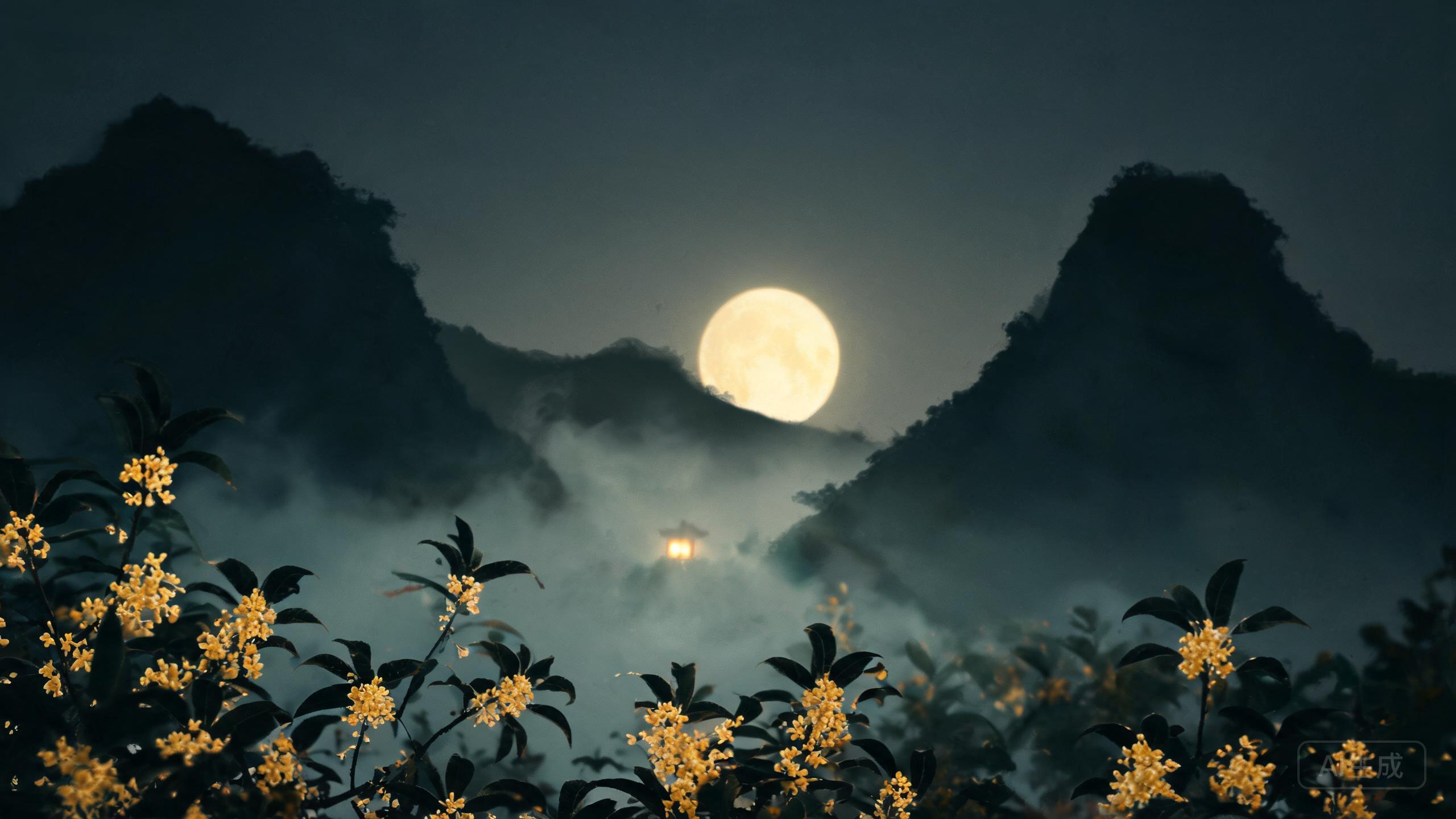
Journal · A Mid-Autumn Meditation
One Moon, Two Mountains
Or how the moon can lift you across distance
Or how the moon can lift you across distance
Tonight the moon is full, round as a reunion, and somewhere a small golden bloom is releasing its scent into the evening air. If you are reading this, the chances are good that you are not where you grew up, and that the people you love are not all at the same table. This night was invented for exactly that gap.
In China, the night of the harvest moon is the night of reunion. Families gather, share round cakes, set a bowl of osmanthus tea on the table, and point at the moon. It is the one night on the calendar when being far away is felt most sharply — because the whole point of the night is togetherness, and the whole shape of the moon is a circle that stands for making whole. If you are away from home on Mid-Autumn, the festival does not politely ignore it. It shows you the full moon and lets the missing sit there, unglossed, under a sky that seems to be asking how you are doing with all of it.
There is an old line that carries the whole feeling of the night, and it does something quiet that makes it worth standing with for a moment.
Two things are happening in that verse. The first is obvious: the moon is being used as a promise that people apart are, in some real sense, not apart — you and the ones you love watch the same moon at the same moment, and so you are together under the one thing neither distance nor duty can divide. The second thing is stranger and worth sitting with: the line does not ask the moon to bring anyone home. It asks the moon to hold you and the ones you miss in a single gaze. The remedy is not arrival. The remedy is being seen together.
That is a different kind of comfort than "you'll be home soon." It is a comfort that works even when there is no plan to go home, even when home is a complicated word, even when the people you miss are people you have decided not to return to. And it is a comfort that a Second Mountain understands naturally — because it was built on the same move Two Mountains keep making: take one real ache, and let two traditions hold it from different sides.
Think about what the moon actually does, not poetically but practically. It is the one object every human on the night side of the earth can look at without anything between them and it. No border, no time zone, no silence can intercept it. Confucian family thought was built on the near — the rites, the table, the parent and child in the same room. But the moon was the piece of the tradition that let the near stretch all the way to the far, so that a son in the capital could honor his mother in the village by looking at the thing she was also looking at. Longing, in that tradition, was not the failure of family. It was the proof that family does not stop at the wall.
Western stoicism approaches the same ache from a different door. Marcus Aurelius, writing to himself in a war tent far from Rome, kept returning to one idea: we are all, at once, in the same cosmos, and the things that divide us are mostly small and mostly invented. The stoic does not console himself by promising he'll get home. He consoles himself by noticing that the thing he believes separates him — the miles, the silence, the absence — was never the real substance of the bond to begin with. If the closeness was real, it is still real, because closeness was never a measurement of distance.
Here the two mountains are not opposed; they lean on each other. The Confucian line gives you the image — the shared moon, the simultaneous gaze. The stoic line gives you the reason — that what joins you was never broken by space, so there is nothing for the space to break. One gives the ache a beautiful shape. The other takes the brokenness out of the ache. Together they turn "I am far from the people I love" from a sentence about loss into a sentence about how love travels.
But the moon is only half this night. The other half is a small bloom that almost nobody outside this festival notices, yet it may be the truest part of the whole thing: the osmanthus flower. Half a centimeter, gold, discreet. And its presence is not mostly seen — it is smelled. The scent of osmanthus comes to you before you see it, a sweet white note that stops you in the middle of an ordinary street in September, and for one second you are not where you are; you are at the doorstep of somewhere you used to be.
There is real, non-poetic truth in this. Smell is the shortest route to memory in the human brain — it bypasses the careful reasoning centers and goes straight to the place where scenes are stored with their feelings attached. One whiff of osmanthus in tea, or osmanthus in a pastry, or osmanthus carried on a gust of cool autumn air, can deliver the whole of a home — the table, the voices, the person who set the bowl down — with an immediacy no photograph has. The moon asks you to deliberately think of the ones you miss. The osmanthus does not ask. It just delivers them.
That is why the two images belong together on this night. The moon is the tradition's effort — the discipline of turning your attention toward the far ones. The osmanthus is memory's gift — the unbidden arrival of home in a scent. Together they hold both directions of longing: the one you choose, and the one that chooses you.
There is another word the festival turns on, and it is worth saying because English has no single clean equivalent: guxiang, 故乡, literally "old home." It does not always mean the address of your childhood, and it does not have to mean a place you still live in. It means the place your memories have been folded into — the one that can be carried inside you and still be missed as if it were far away. It is possible to be standing in your hometown and feel far from guxiang. It is possible to have no hometown at all and still grieve one.
This is the quieter truth of the festival, the one under the roundness: guxiang is not a place on the map. It is a place in the heart that you keep returning to with your attention, even when nothing will take your body there. And the Mid-Autumn moon is the festival's way of giving that inner return a date and a shape.
Read the second half of that line without reaching for "the hometown moon is literally brighter," because it is not literally brighter — the moon is the same moon. What Du Fu is marking is that brightness is not a property of the sky. It is a property of attention. The moon over the place you belong is brighter because you are brighter there; your whole self is aimed at it, unguarded, the way a child leans into the light. Home is not where the ground is. Home is where your attention rests easily — and the strain of being far is, in part, the strain of having to hold your attention where it does not want to rest.
The stoic reading which I keep being drawn back to says almost the same thing from the other direction: what you love, you are already attending to, and attention is a kind of dwelling. You can be a thousand miles from the people you love and still be with them in the only sense that has ever mattered, because to love someone is to keep them in the room of your mind. Distance separates bodies. It has never once separated the particular form of attention that love is.
Which brings this meditation to its real subject: reunion. Because the festival is built on it, but if you look closely, the festival is also quietly teaching you that reunion and wholeness were never the same thing as everyone in one room.
Consider the two ways to read the full moon. The first way sees it as a promise: one day we'll all sit at the same table and it will be this round, this complete, this unhurried, and then we will finally be whole. This is the reading that makes longing feel like waiting, and waiting like a kind of poverty — as if you are poor until the roundness arrives in person.
The second way sees the full moon as a reminder: the circle was always complete, not because everyone is here, but because the bond was never contingent on the gathering. The moon is full regardless of who can see it, the way a love is whole regardless of who is present to hold it. This is the reading that lets you be at the farthest point on earth and still recognize, in the middle of the missing, that you are not actually missing a piece of yourself in the way you feared. You are carrying it.
The moon gives you the image: we who are apart are together. The osmanthus gives you the proof: home arrives uninvited. And the word guxiang gives you the truth: the place you carry is where you belong.
Two Mountains was named for exactly this logic. The point was never to pick one mountain and move to it, to resolve the tension by choosing a side. The point was to stand in the valley and hold two true things at once — the East, which makes the ache beautiful by giving it a shared moon and an old-home word; the West, which makes the ache bearable by showing that what joins you was never broken by miles. Most advice tells you to stop missing it. These two traditions, together, tell you the better thing: that missing it is what proves you found it.
This year, whatever your table looks like — full, half-empty, or empty of everyone you grew up around — I hope the moon is generous with you, and that the scent of osmanthus, whenever it finds you, brings you all the way home to the place you carry. You are not waiting to be whole. You are whole, and tonight you get to notice it.
Loneliness, missing someone, feeling unseen — describe what's on your mind and let Laozi and Marcus hold it from both sides. Try it free, then from $7.8/mo.
Try Two Mountains Free